
Where the 25 percent rule actually comes from
Ask around after a hailstorm and you will hear about "the 25 percent rule": if more than a quarter of a roof is damaged, the whole thing has to be replaced. It is real, but it is a Florida law. Section 706.1.1 of the Florida Building Code, Existing Building volume, says that no more than 25 percent of the total roof area, or of a roof section, may be repaired, replaced or recovered in any 12-month period unless the entire roof or section is brought up to current code. Florida wrote it for hurricane country. It has been argued about in Florida ever since, narrowed in the 2023 edition and given an exception for roofs built to the 2007 code or later.
Indiana has no such rule
We looked, because customers keep asking. The 2020 Indiana Residential Code, which is the 2018 International Residential Code adopted under 675 IAC 14-4.4, sets out how a roof is repaired or replaced in Section R908 and contains no percentage threshold of any kind. The Indiana Building Code's existing-buildings chapter (675 IAC 13-2.6-34) has none either, and Indiana has not adopted a separate existing-building code. The only "25 percent" on the books anywhere near Greenwood is the city's permit trigger: remove 25 percent or more of the roof decking and you need a building permit. That is about paperwork for structural work, not a rule that a quarter-damaged roof must be replaced.
So why does it come up on insurance claims?
Because both sides borrow it. A homeowner who has heard the rule may expect a full replacement once a few slopes show hail bruising; an adjuster may cite it, or its absence, to justify patching one slope and leaving the rest. Neither is standing on Indiana law. Indiana has no shingle-matching statute and the Indiana Department of Insurance has issued no bulletin on it, so whether a partial repair that leaves a visible mismatch is acceptable comes down to the wording of your policy. In one case we found, Erie Insurance Exchange v. Sams (Indiana Court of Appeals, 2014), replacement-cost coverage was read to cover the entire roof and siding where a mismatched partial repair would have lowered the home's value. That was a ruling about one policy's language, not a rule every carrier follows, and we would never promise you a match.
What we do instead of quoting a rule
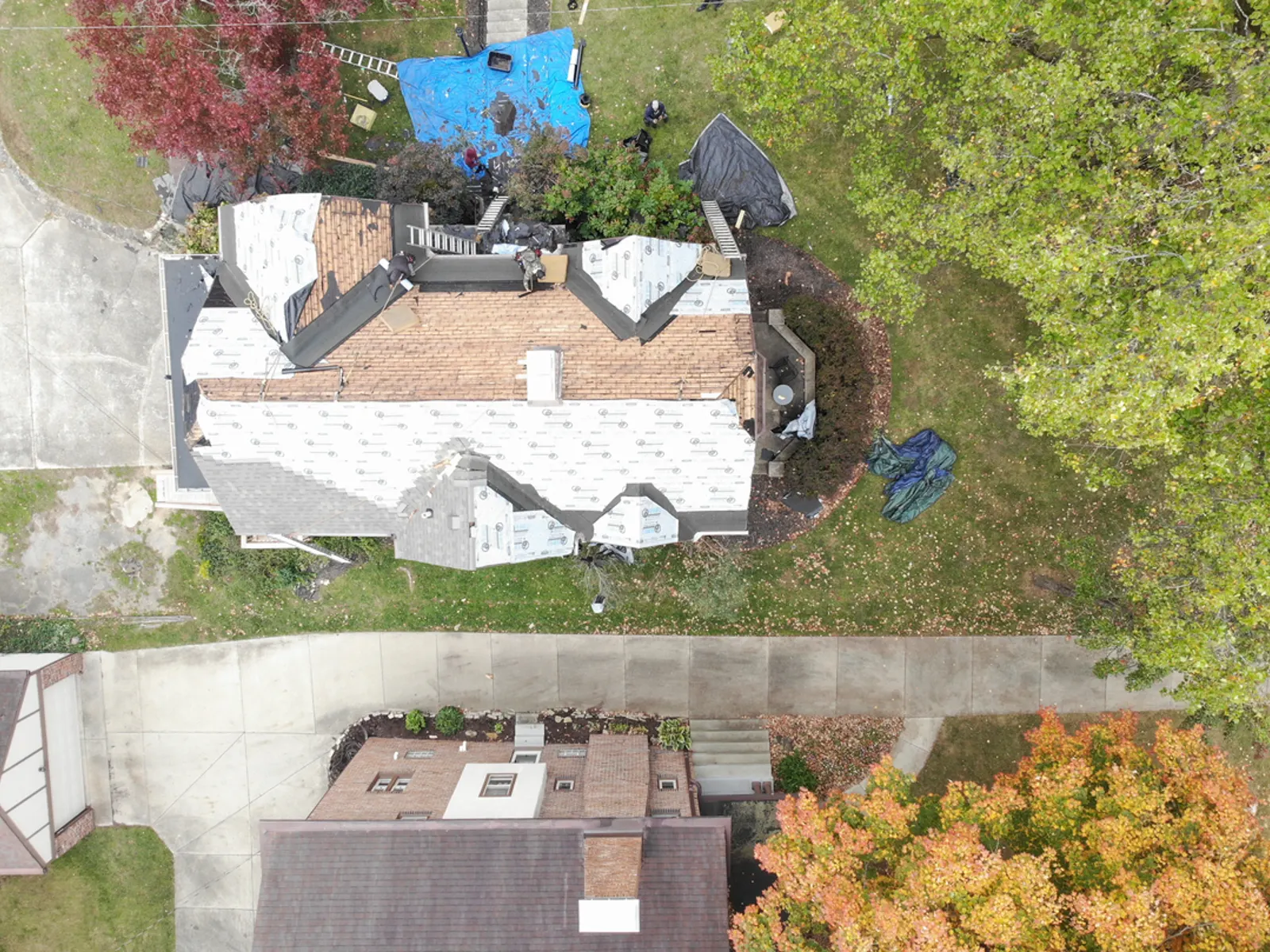
- Document every slope. Drone photos of the whole roof, ridge, valleys and flashing, dated, before the claim is filed. Adjusters argue with opinions; they rarely argue with photos.
- Show the damage slope by slope. The dated drone photos show how much of each slope is actually hit, so the claim rests on what is there instead of on a percentage someone quoted.
- Meet the adjuster on the roof. Jake walks it with them so the slopes that took damage are in the report the first time.
- Tell you straight if it's a repair. One slope of damage on a young roof is a repair. A roof with hail on three slopes and shingles at the end of their life is a replacement claim. We say which, in writing, and the photos back it up.
25 percent rule questions, answered first
No. It is Section 706.1.1 of Florida's existing-building code. Indiana's residential and building codes contain no percentage threshold for roof repair or replacement.
A permit trigger, not a replacement rule. Greenwood requires a building permit when 25 percent or more of the roof decking is removed. It says nothing about how much damaged shingle means a new roof.
It depends on your policy's wording, not on a rule. Indiana has no matching statute. One 2014 Indiana appeals case read replacement-cost coverage to include the whole roof where a partial repair would not match, but every claim is decided on its own policy. We document everything so your claim is argued from evidence.
Get the roof documented first. Our storm inspection is free, the drone photos are dated, and we meet the adjuster on the roof with them.
Sources
- Florida Building Commission, DS 2021-007 staff analysis (FBC-EB 706.1.1) and the 2023 analysis of changes
- Indiana Residential Code: 675 IAC 14-4.4; Chapter 9, Section R908; Indiana Building Code existing buildings 675 IAC 13-2.6-34
- City of Greenwood, Do I need a permit?
- Indiana Department of Insurance, laws, rules and bulletins; Erie Insurance Exchange v. Sams, 20 N.E.3d 182 (Ind. Ct. App. 2014)